There are unveilings that arrive with fanfare — the flash of cameras, the rustle of programmes, the choreography of dignitaries. And then there are unveilings that begin in silence. In rooms where recovery is slow. In corridors where dignity is rebuilt. In institutions that have been doing the work long before the world learned their names.
For the HealthyMinds Wellness Initiative, the story of its public emergence did not begin on a stage. It began in Budo‑Egba.
On 2nd June 2026, the day before its formal unveiling, the Initiative — led by its Founder and CEO, Dr. Simeon Yinka Diran Ategbese — made a choice that would define its identity. Instead of rehearsing speeches or perfecting protocol, the team travelled to the Federal Neuropsychiatric Hospital, Budo‑Egba, Kwara State. As the document notes, the visit “said more about its character than any mission statement could.”
It was a beginning rooted not in performance, but in presence.
A Hospital That Holds More Than Patients
The Federal Neuropsychiatric Hospital, Budo‑Egba is not the kind of place most Nigerians imagine when they hear the words “psychiatric hospital.” It is not a holding facility. It is not a place of confinement. It is, as the report describes, “a place built around the full arc of recovery — from the most acute phase of illness through rehabilitation and, ultimately, reintegration into society.”
Its architecture of care is deliberate:
• The Mental Health Center — where acute cases are stabilised with clinical precision and human sensitivity.
• The Rehabilitation Center — where patients relearn the rhythms of daily life.
• The Halfway Home Unit — a supervised bridge between institutional care and independence.
This tiered model is rare in Nigeria. It is thoughtful, coherent, and quietly revolutionary.
The Case That Revealed a Philosophy
During the briefing, the HealthyMinds team was presented with a clinical case involving Substance Use Disorder — one of the most misunderstood and stigmatised conditions in the country. The hospital’s approach rested on four pillars:
• Holistic intake assessment
• Individualised treatment planning
• Sustained psychosocial support
• Structured monitoring
What stood out was not the clinical detail but the ethos behind it. The report emphasises that the hospital is committed to “seeing patients fully… their history, their environment, their relationships, and their capacity for recovery.”
This is not just treatment. It is a worldview.
 A Walk Through the Wards
When Prof. Issa Baba Awoye, the Medical Director, led the team through selected wards, the atmosphere was striking. Not tense. Not chaotic. But calm — “genuinely, visibly calm,” the document notes.
Patients moved with composure. Their interactions were warm, ordinary, human. The kind of ordinariness that signals something profound: stability.
“They are all responding positively to treatment,” Prof. Awoye said, a simple sentence carrying the weight of years of work.
For HealthyMinds, this was a revelation. Dignity was not an aspiration here; it was an observable reality.
A Hospital Carrying a Region
One detail lingered long after the visit: patients come not only from Kwara State but from Maiduguri, Bida, and communities far beyond. This is not a logistical footnote. It is a national signal.
It means:
• Specialist psychiatric care remains scarce across northern and central Nigeria.
• Families are travelling hundreds of kilometres for help.
• Budo‑Egba is carrying a burden far larger than its geographic footprint.
The report captures this clearly: the hospital’s catchment area “is not merely a logistical fact — it is a policy signal.”
The Economics of Access
The hospital shared its fee structure openly:
• General Mental illness admission cost (Monthly): ₦250,000
• In-patient Rehabilitation cost (Monthly): ₦400,000
The cost include feeding, medications, investigations amongst others
These figures were recorded “not as critique but as context,” the document states.
For HealthyMinds, understanding the financial barriers to care is inseparable from advocacy. Mental health access is not only a clinical issue — it is an economic one.
A Gesture Without Applause
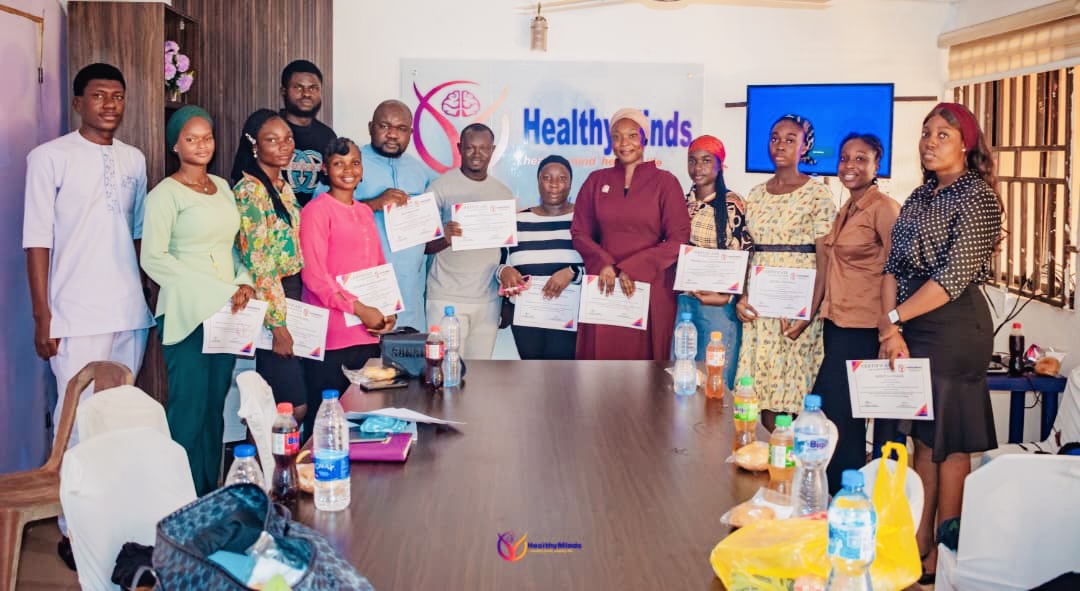
Before departing, HealthyMinds presented the hospital with material donations — a gesture planned quietly, without cameras or theatrics. The report describes it as “the straightforward expression of a conviction… that advancing mental health in Nigeria is not only a matter of raising awareness or shaping policy, but of standing beside the institutions already doing the work.” An award of recognition was also presented to the Medical director for his outstanding leadership role as the pioneer medical director of the institution
It was solidarity, not symbolism.
What HealthyMinds Carried Forward
The team left Budo‑Egba with four insights that will shape its future work:
• A replicable tiered model of care
• A culture of dignity worth protecting
• A regional gap demanding policy attention
• A principled approach to admissions
These were not abstract lessons. They were the foundation of a movement.
A Beginning Rooted in Humanity
“The patients in those wards are not abstractions… They are the reason the HealthyMinds Wellness Initiative exists.”
And so, before the speeches, before the applause, before the unveiling — HealthyMinds began exactly where it needed to: beside the people and institutions who live the work every day.